Activation leaks
Find the exact onboarding step where users stop and review sessions from that transition.
Conversion funnel analytics
Build funnels for signup, onboarding, activation, purchase, forms, and feature adoption. Then use replay, heatmaps, and feedback to understand why users stop.
Problems it solves
Find the exact onboarding step where users stop and review sessions from that transition.
Validate funnel steps with recordings so the funnel represents user progress, not just component renders.
Use replay, heatmaps, and feedback to turn a drop-off number into a shared product hypothesis.
Activation funnels
Measure the share of new signups that reach your activation event, not just the ones that finish onboarding.
See which onboarding step loses the most users, then open the recordings of the sessions that stalled there.
Workflow
Create funnels around user intent within a visit: landed, viewed pricing, started signup, signed up, created a workspace.
Track conversion rate and drop-off across each step, on desktop and mobile.
Open recordings, heatmaps, errors, and feedback from the weak transition.
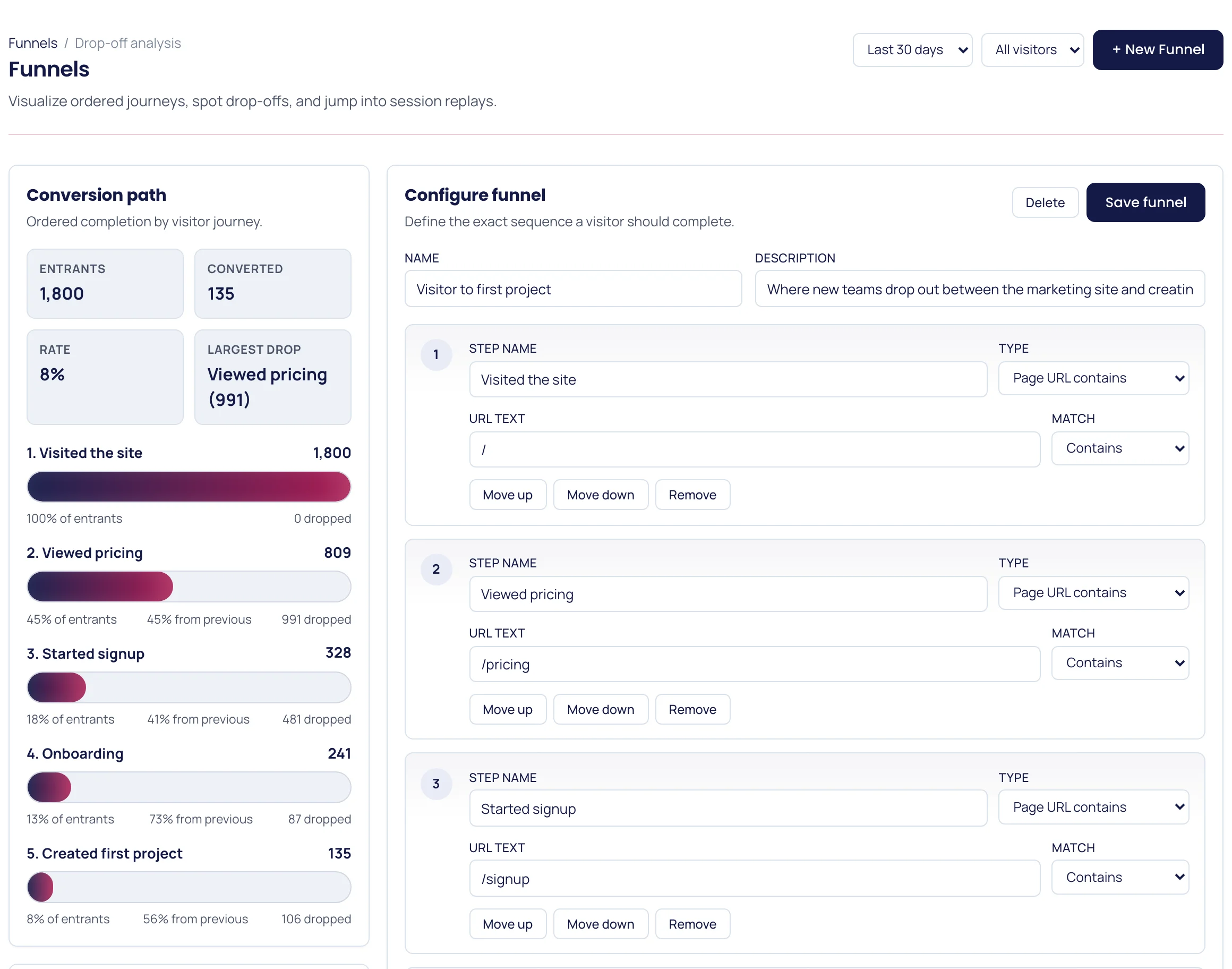
How it counts
Ordered steps, matched one visit at a time, with the replays of the visits that stopped one click from the number.
A funnel in PulsePanda is an ordered list of steps, evaluated one visit at a time. A visit carries across page loads and across new tabs opened within 30 minutes, so a signup that starts on the pricing page and finishes in a second tab is still one journey.
Within each visit, events are put in time order and the steps are matched in sequence. A visit has to reach step one before step two can count, but other things can happen in between: a visitor who reads the docs between starting signup and finishing it still converts. Each visit counts once per step, however many times it repeats one.
Every step reports three numbers:
The step that loses the most visits is called out as the largest drop, and a sample of the visits that stopped is listed with a link straight to each session replay, so “why here?” is one click from the number.
You can look at the last 7, 30 or 90 days and split any funnel into desktop and mobile visits. That split is usually the first one worth making: a form that works on a laptop and fails on a phone looks like one leaky step until you separate them.
Steps
Mix them in one funnel. The most useful funnels combine pages reached with one or two events.
| Page URL | The visit reached a page whose URL contains, or exactly matches, the text you give: /pricing, /signup, /onboarding. It needs no instrumentation, and the page a form leads to is usually the most honest sign that the form worked. |
|---|---|
| Event type | Any event of a type the script already records: a click, an input, a rage click, a JavaScript error, a feedback submission, an announcement view. Useful for steps like “hit an error” or “gave feedback”. |
| Defined event | A click event you defined from autocaptured clicks, by element id, class, text or tag. The definition applies to clicks recorded before you made it, so a new funnel can use last month's data. |
| Tracked event | A named event you send with PulsePanda.track(), such as workspace_created or plan_upgraded. The right step for outcomes that have no page of their own. |
What you get
| Signup funnels | Understand where trial users abandon account creation or workspace setup. |
|---|---|
| Activation funnels | Track whether users reach the first valuable product moment. |
| Form funnels | Find validation, trust, and layout problems that block submissions. |
Examples
Most SaaS teams need the same three funnels before any others. Each is written as the steps you would enter.
| Funnel | Steps | What a leak usually means |
|---|---|---|
| Signup (conversion) funnel | Page /pricing → page /signup → page /welcome | Pricing to signup: the plan or the price is unclear. Signup to welcome: the form is failing, often on mobile or on one validation rule. |
| Onboarding funnel | Page /welcome → tracked workspace_created → tracked teammate_invited | A step nobody finishes usually asks for something the user does not have yet: a teammate's email, a data source, an API key. |
| Activation funnel | Page /dashboard → tracked project_created → tracked report_viewed | Users who set up and never reach the first useful result. This is the funnel that shows churn before it happens. |
An onboarding funnel measures whether people finish the setup you designed. An activation funnel measures whether they reach the moment the product is useful. The two overlap, and the gap between them is where most early churn hides. If you have not decided what “activated” means yet, activation funnel benchmarks covers how, and what an onboarding funnel is walks through the steps.
Steps are matched within one visit, so these funnels describe what happens in a sitting. When activation normally takes several days, read the funnel alongside cohort retention.
Pitfalls
/” is true of every page, so the funnel starts with every visit on the site. Start from the page where the journey really begins, or use an exact match.FAQ
Conversion funnel analytics measures how users move through a sequence of steps, such as signup, onboarding, activation, purchase, or form submission.
Funnels show where users drop off. Recordings, heatmaps, errors, and feedback help explain why the drop-off happened.
Yes. PulsePanda is built for SaaS teams that need to track activation steps and connect those steps to user behavior evidence.
FAQ
An activation funnel counts how many new users reach the first moment your product is useful to them, such as creating a first project and viewing a first report, and shows the step where the rest stop. It differs from an onboarding funnel, which measures whether people finish the setup steps you designed.
The sequence of setup steps a new user goes through after signing up, such as creating a workspace, inviting a teammate and connecting data. Its drop-off shows which setup step asks too much.
No. Steps are matched within one visit, which carries across page loads and new tabs opened within 30 minutes. For journeys that take days, read the funnel alongside cohort retention.
Yes. A step can be a page URL, any event type the script records, a click event you defined from autocaptured clicks, or a named event sent with PulsePanda.track().
Yes. Each funnel lists a sample of the visits that stopped, each linked to its session replay.
Related pages
Install once and connect product analytics, replay, heatmaps, funnels, and feedback in minutes.
Start for free